
Getting Started with RefTreeAnalyser
Pages in this article
- Why RefTreeAnalyser?
- Screenshots of RefTreeAnalyser
- Version information
- Quick Operating instructions
- Full help
Install the add-in, then follow a formula back to its inputs. For detailed command instructions, use the help manual.
Before you start
Use desktop Excel for Windows or Microsoft 365 for Mac. Check the supported versions and Mac limitations. No license key is needed for demo mode; see the demo restrictions.
Read the readme.txt included in the download. If your organization manages add-ins or macro permissions, follow its installation policy.
Install on Windows
- Right-click the downloaded zip file and choose Properties. If an Unblock checkbox is shown, check it and click OK.
- Extract all files to a folder you intend to keep. Do not open the add-in from inside the zip file or a temporary folder.
- Open the extracted RefTreeAnalyserXL.xlam file in Excel.
- If Excel prompts about macros, enable them only if you trust the download and your organization's policy permits it. Do not lower Excel's global macro-security settings.
- When RefTreeAnalyser asks whether to install itself as an add-in, choose Yes to load it whenever Excel starts. Choosing No loads it for the current session without installing it for future sessions.
Install on Mac
- Extract the downloaded zip file and keep all its files together in a folder you intend to keep. The Windows Properties/Unblock step does not apply.
- In desktop Excel, open the extracted RefTreeAnalyserXL.xlam file.
- Allow macros only if you trust the download and your organization's policy permits it.
- When RefTreeAnalyser asks whether to install itself as an add-in, choose Yes to make it available when Excel starts.
Trace your first formula
After installation, look for the RefTreeAnalyser tab on Excel's ribbon:

- Open a workbook and select a formula cell that refers to other cells. Avoid starting with a cell inside a PivotTable: the precedents command navigates to its source range instead.
- Choose Precedents on the RefTreeAnalyser tab.
- In the reference tree, click an input reference. Excel selects the corresponding cell or range.
- If a reference has child entries, expand it to follow the calculation further. Demo mode is limited to one level; a licensed version can trace more levels.
- Close the tracing window when you have finished. Reopen it for another formula, or choose Find Dependents to investigate which calculations use the selected cell.
You have completed your first trace when a reference in the tree takes you to the expected input range. For the window's controls and reporting options, see working with the reference tree.
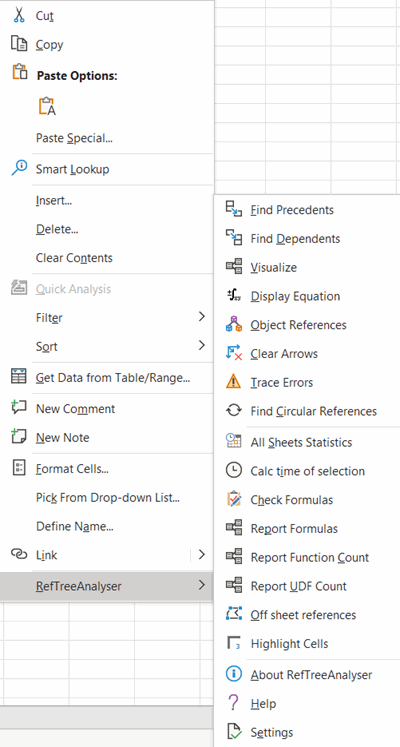
Many commands are also available from a cell's right-click menu:
If something does not appear
- No RefTreeAnalyser tab: confirm that you opened the extracted .xlam file and that Excel allowed its macros. See Excel add-ins fail to load.
- Your organization blocks ribbon changes: see the manual's ribbon-policy guidance.
- No references in the tree: try a simple formula
such as
=A1+B1, with numbers in A1 and B1, rather than a constant or a formula without cell references. - A window is not visible: see resetting dialog positions.
Choose your next task
Explore workbook-review use cases, see report examples, or activate a license key.


Installation questions
Do I have to install the add-in to try it?
No. You can decline the installation prompt and use it for the current Excel session. Install it if you want it to load automatically when Excel starts.
Should I move the extracted files afterward?
Choose a lasting location before installing. Excel's add-in entry points to that location; moving or deleting the files can prevent the add-in from loading next time.
Comments